B13. Rice,
R. E. & Atkin, C. K. (Eds.) (2012). Public communication
campaigns (4th ed). Thousand Oaks, CA: Sage. ISBN
9781412987707[Translated
and
published in Korean by CommunicationBooks, Inc. Mapo-go, Seoul, Korea,
2013;
ISBN 979-11-304-3583-1 93300.]
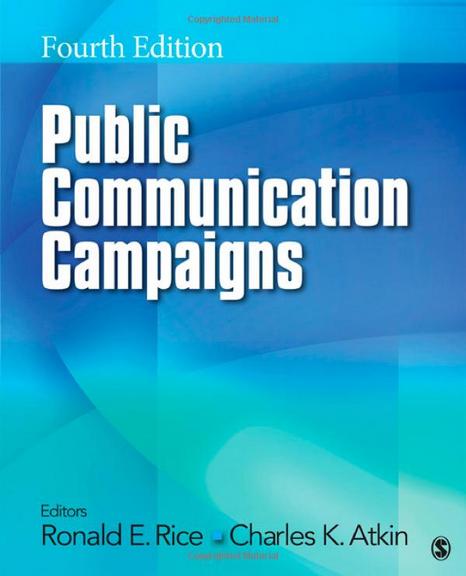 In this fully revised and
expanded Fourth Edition, Ronald E. Rice and Charles K. Atkin
provide readers with a comprehensive, up-to-date look into the field of
public communication campaigns. Updated to reflect the latest theories
and research, this text extends coverage to new areas, including sun
protection, organ donation, human rights, social norms, corporate
social responsibility, condom use, ocean sustainability, fear messages,
and digital games. Classic chapters include updates on topics such as
campaign history, theoretical foundations, formative evaluation,
systems approaches, input-output persuasion matrix, design and
evaluation, meta-analysis, and sense-making methodology.
In this fully revised and
expanded Fourth Edition, Ronald E. Rice and Charles K. Atkin
provide readers with a comprehensive, up-to-date look into the field of
public communication campaigns. Updated to reflect the latest theories
and research, this text extends coverage to new areas, including sun
protection, organ donation, human rights, social norms, corporate
social responsibility, condom use, ocean sustainability, fear messages,
and digital games. Classic chapters include updates on topics such as
campaign history, theoretical foundations, formative evaluation,
systems approaches, input-output persuasion matrix, design and
evaluation, meta-analysis, and sense-making methodology.
http://www.sagepub.com/books/Book234975?siteId=sage-us&prodTypes=any&q=public+communication+campaigns&fs=1
Table of Contents
Preface and Acknowledgements
Mission, Market, Major Features and Benefits, Changes from the 3rd
Edition, Acknowledgments
Section 1. Overview and History
1. Theory and Principles of
Public Communication Campaigns
Charles K. Atkin, Ronald E. Rice
Theoretical Foundations of Campaigns; Audience Segmentation and
Campaign Design; Campaign Messages and Media; Campaign Evaluation
Methods; Future Challenges; Conclusion; Additional Resources for
Campaign Design and Research Information; References
2. Public Communication Campaigns: The
American Experience
William Paisley, Charles K. Atkin
Campaign Stakeholders; Defining Characteristics of Public Communication
Campaigns; The Essential Concepts of Agenda and Entitlement; Three
Centuries of American Public Communication Campaigns; A New Century of
Public Communication Campaigns; Conclusion; References
3. Why Can't We Sell Human Rights Like
We Sell Soap?
Robert C. Hornik
Three Traditions of Communication and Social Change Scholarship; How Do
Scholars of Purposive Communication and Social Change Think about
Behavior?; What Issues Will "Human Rights Communication" Need to
Address?; Conclusions; References
Section 2. Design and Evaluation
4. Guidelines for Formative
Evaluation in Campaign Design
Charles K. Atkin, Vicki Freimuth
Conceptual Framework for Campaign Persuasion; Preproduction Research;
Pretesting Research; Types of Pretesting; Conclusion; References
5. A Systems-Based Evaluation Planning
Model for Health Communication Campaigns in Developing Countries
Ronald E. Rice, Dennis Foote
Specifying the Goals, Assumptions, and Related Projects; Specifying the
System and the Process Model; Specifying Prior States and System
Phases; Specifying System Constraints and Intervention Inputs;
Specifying Immediate and Long-term Goals; Specifying the Process Model
at the Individual Level; Choosing among Research Approaches;
Implications for Design; Conclusion; References
6. Evaluating Communication Campaigns
Tom Valente, Patchareeya P. Kwan
The Nature of Evaluation; Evaluation Frameworks; Summative Evaluation
Research; Dissemination of Findings; Conclusion; References
7. Communication Campaign
Effectiveness and Effects: Some Critical Distinctions
Charles T. Salmon, Lisa Murray-Johnson
What Constitutes an Effective Campaign?; Explicating Campaign
Effectiveness; Distinguishing Between Campaign Effects and
Effectiveness; Conclusion; References
8. How Effective are Mediated Health
Campaigns? A Synthesis of Meta-Analyses
Leslie B. Snyder, Jessica M. LaCroix
Method; Media Campaign Effects by Health Topic; Additional Moderators
of Media Campaign Effects; Comparing Media Campaigns to Other
Approaches; Conclusions; References
Section 3. Theory Foundations
9. McGuire's Classic
Input-Output Framework for Constructing Persuasive Messages
William McGuire
Promising Input Topics on How Communications Can Be Made More
Persuasive; Promising Output Topics on How Persuasion Works; Some Basic
Implications; References
10. Sense-Making Methodology as an
Approach to Understanding and Designing for Campaign Audiences: A Turn
to Communicating Communicatively
Brenda Dervin, Lois Foreman-Wernet
Historical Background; The Communicative Premises of the Public
Communication Campaign; The Communication Theories Driving Public
Communication Campaigns; Critiques of Dominant Approaches; What Is
Different about Sense-Making Methodology (SMM): Fundamental
Assumptions; Sense-Making Methodology: The Central Metaphor that Drives
Practice; SMM Applications; Sense-Making Methodology: Between the
Cracks and Against the Grain; Notes; References
11. Inducing Fear as a Public
Communication Campaign Strategy
Marco C. Yzer, Brian G. Southwell, Michael T. Stephenson
The Function of Fear; Perceived Risk and Fear; Fear Appeal Theories;
Research Evidence for Fear Appeal Effects; Fear Appeals in a Public
Communication Context; Conclusion; References
12. Truth in Advertising: Social Norms
Marketing Campaigns to Reduce College Student Drinking
William DeJong, Sandi W. Smith
Overview of Social Norms and College Drinking; University of Virginia
Case Study; Michigan State University Case Study; Lessons Learned from
Recent Research; Conclusion; References
Section 4. Applying Theory and
Evaluation
13. The Go Sun Smart Campaign:
Achieving Individual and Organizational Change for Occupational Sun
Protection
David B. Buller, Barbara J. Walkosz, Peter A. Andersen, Michael D.
Scott, Mark B. Dignan, Gary R. Cutter
Conceptual Basis of Go Sun Smart; The Go Sun Smart Program; The Go Sun
Smart Effectiveness Trial; The Industry-wide Dissemination Trial on Go
Sun Smart; General Conclusions and Next Steps; References
14. A Mass Media Campaign to Increase
Condom Use among High Sensation-Seeking and Impulsive Decision-Making
Young Adults
Philip C. Palmgreen, Seth M. Noar, Rick S. Zimmerman
Safer Sex Campaign Study; Study Design; Results; Discussion; References
15. Public Communication Campaigns to
Promote Organ Donation: Theory, Design, and Implementation
Susan E. Morgan
Theoretical Foundations of Organ Donation Campaigns; Worksite
Campaigns; Campaigns for Targeted Populations; Drivers License Bureau
Campaigns; Conclusion; References
16. Transdisciplinary Approaches for
Twenty-First Century Ocean Sustainability Communication
Ronald E. Rice, Julie A. Robinson
Revealing and Dealing with Blind Spots in Ocean Communication through
Transdisciplinary Approaches; Examining the Case of Sustainable Seafood
Using the Ocean Communication Model; Conclusion: The Holistic View;
References
17. Sociocognitive Approaches for AIDS
Prevention: Explicating the Role of Risk Perceptions and Efficacy
Beliefs in Malawi
Rajiv N. Rimal, Rupali Limaye
Role of Behavior Change; Theoretical Background; The Risk Perception
Attitude (RPA) Framework; The Malawi BRIDGE Project: A Multilevel
Approach; A Finer Focus on Behaviors: A Case Study of Condom Use;
Conclusions and Future Research; References
18. Corporate Social Responsibility
Campaigns: What Do They Tell Us about Organization-Public Relationships?
Maureen Taylor
CSR Campaigns; Perspectives on CSR as a Business Function; CSR as a
Relationship Building and Social Capital Formation Function; Case
Studies of CSR; Corporate Social Responsibility Campaigns Contribute to
a Fully Functioning Society; Conclusion; References
19. Designing Digital Games, Social
Media, and Mobile Technologies to Motivate and Support Health Behavior
Change
Debra A. Lieberman
Advantages of Games for Health Promotion and Behavior Change; Wide
Range of Digital Game Formats; Theory and Research - Obesity Prevention
Example; 3D Body Model: Your Game Character or Game World Could
Be.You; Conclusion; References
20. Community Partnership Strategies
in Health Campaigns
Neil Bracht, Ronald E. Rice
Community Collaboration: Perspectives on Partnership Approaches;
Community Change Theory: Multiple Approaches; Basic Strategies in
Organizing Community Campaigns: A Five-Stage Model; Conclusion;
References
21. Closing the Gap in Practice and in
Theory: Evaluation of the Scrutinize HIV campaign in South Africa
D. Lawrence Kincaid, Richard Delate, Douglas Storey, Maria Elena
Figueroa
Theory-Based Communication Cycle of Effective Health Communication
Programs; The Scrutinize HIV Prevention Campaign of South Africa;
Impact Evaluation; Conclusion; References
22. The Rising Tide of
Entertainment-Education in Communication Campaigns
Arvind Singhal, Hua Wang, Everett M. Rogers
The Entertainment-Education Strategy; Soul City: An
Entertainment-Education Exemplar; Emerging Trends in
Entertainment-Education; Looking Back and Looking Forward; References
23. Putting Policy into Health
Communication: The Role of Media Advocacy
Lori Dorfman, Lawrence Wallack
Health Communication Campaigns; Media Advocacy; Conclusion; References
About the Contributors
Index